
Controlling Temperature in a Grow Room: How to Keep Cannabis Healthy and Stress Free
Controlling temperature is one of the most important parts […]


 0
0
Curing cannabis is the controlled aging process that happens after drying, where moisture slowly redistributes inside the flower and remaining plant compounds stabilize over time.
Curing cannabis does not add terpenes or increase potency.
It preserves what was already grown.
The purpose of curing is consistency, smoothness, and long-term quality.
If drying is rushed or poorly controlled, curing cannot fully correct the damage. This is why curing must be viewed as part of a larger post-harvest system that starts with proper harvest timing and continues through drying and storage.
Drying and curing are often confused, but they are not the same.
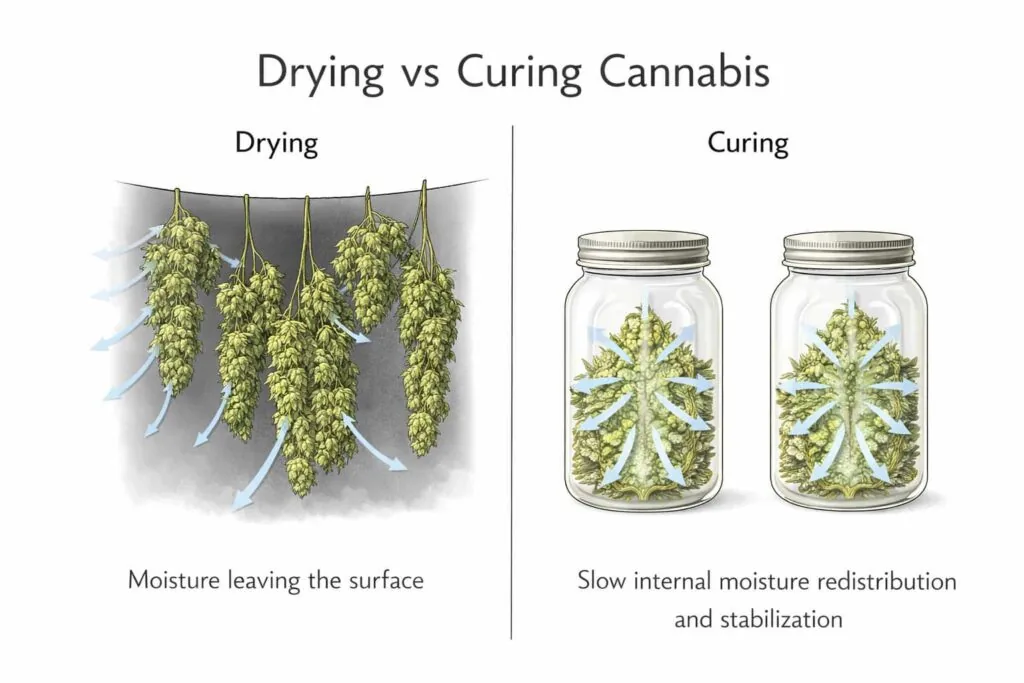
Drying removes surface moisture so flowers are safe to store.
Curing is the slow internal stabilization that follows.
If flowers are exposed to excessive heat or dry air during drying, terpene loss and harshness increase. This is closely tied to grow room temperature and humidity in the final weeks before harvest and during post-harvest handling.
| Step | What It Does | Timeframe |
|---|---|---|
| Drying | Removes excess surface moisture | 7–14 days |
| Curing | Equalizes internal moisture and stabilizes compounds | 2–8 weeks |
If drying is rushed, curing cannot fully fix the damage.
Plant chemistry and post-harvest research give us a clear framework for what curing actually does.
After drying, moisture inside the flower is uneven.
Curing allows moisture to slowly redistribute from the center of the bud outward.
This process:
💡 Source: Post-harvest moisture migration in plant materials
Harshness is often blamed on nutrients, but it is more closely linked to chlorophyll and residual sugars.
During curing:
This process is time-dependent, not flush-dependent.
💡 Source: Chlorophyll degradation during plant senescence
Curing does not generate new terpenes.
It helps preserve existing ones by:
Excess heat or low humidity during curing accelerates terpene loss.
💡 Source: Terpene volatility and degradation
There is no single perfect duration, but general ranges work well.
| Cure Length | What To Expect |
|---|---|
| 7–10 days | Smokeable, but still sharp |
| 2–4 weeks | Noticeably smoother |
| 4–8 weeks | Optimal balance for most strains |
| 3+ months | Flavor plateaus, storage becomes key |
Most quality improvement happens in the first 4 weeks.
Curing works best under stable conditions.
| Factor | Ideal Range |
|---|---|
| Relative Humidity | 58–62% |
| Temperature | 60–68°F |
| Light | Darkness |
| Air Exchange | Minimal, controlled |
Humidity swings are more damaging than slightly imperfect averages.
The container matters more than most people realize.
The goal is controlled exchange, not constant airflow.
| Mistake | Why It Causes Problems |
|---|---|
| Curing wet buds | Traps moisture, risks mold |
| Over-burping jars | Dries flowers too fast |
| Ignoring humidity | Leads to terpene loss |
| Using heat to speed curing | Degrades cannabinoids |
| Expecting curing to fix bad drying | Damage is already done |
Before curing, confirm:
During curing:
No. Potency is set at harvest. Curing preserves cannabinoids, it does not create them.
Yes. Long-term curing without humidity control leads to terpene loss.
No, but uncured cannabis is harsher and less stable.
No directly. Harshness is more influenced by drying and curing quality.
Only slightly. It cannot fix poor genetics, early harvest, or rushed drying.
Curing cannabis is not about transformation.
It is about preservation and consistency.
If the grow was healthy, the harvest was timed correctly, and drying was done slowly, curing allows the flower to settle into its best possible version.
Focus on:
Good curing rewards good fundamentals.
Starting with stable genetics also makes curing easier and more forgiving. Choosing reliable THC seeds helps ensure flowers finish with balanced moisture, strong terpene retention, and fewer post-harvest issues.
Curing does not create quality.
It protects it.
Controlling temperature is one of the most important parts […]
What Is Ice Flushing? Ice flushing weed is the […]
What Is Flushing Cannabis? Flushing cannabis plants means running […]

Knowing when to harvest cannabis is one of the […]
Are you 21 or older?
You must verify that you are 21 years or older to enter this website. By proceeding, you are also agreeing to our terms and conditions, as well as consenting to the use of cookies on this site.