Cap Junky
 Aromatic Fusion of Cream & Coffee
 Designed for Advanced Growers
 Energizing Daytime High
 Euphoric Psychedelic Bliss
 Ideal for Indoor Cultivation
 Impressive Sugar-coated Colas
 Maximizing Yields Indoor & Outdoor
 Up to 35% THC


 0
0
Flushing cannabis plants means running plain water, or very low EC solution, through the growing medium near harvest to reduce nutrient availability at the root zone.
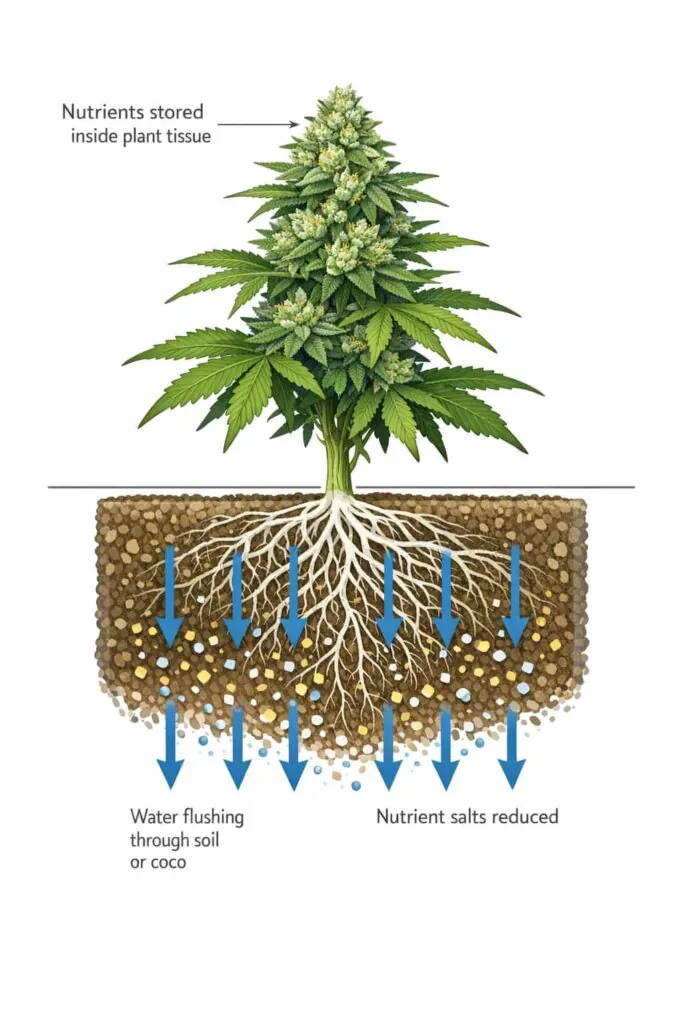
Flushing cannabis does not wash nutrients out of the buds.
It only affects what the roots can access during the final stage of growth.
Growers usually flush cannabis for one of three reasons:
Many growers confuse flushing with improving flavor. That connection is mostly a myth.
Flavor quality is driven far more by harvest timing, drying, and curing, which we cover in detail in our guide to how to time your cannabis harvest correctly.
| Claim | Reality |
|---|---|
| Flushing removes nutrients from buds | Nutrients stored in plant tissue cannot be washed out |
| Flushing improves flavor | Flavor comes mainly from maturity and curing |
| Flushing is mandatory | It is optional and situation dependent |
| No flush equals harsh smoke | Harshness is usually a drying or harvest issue |
Plant science gives us a clear framework for understanding what flushing can and cannot do.
Once a cannabis plant absorbs mineral nutrients through its roots, those nutrients are transported into plant tissues and incorporated into cells, enzymes, and structural compounds. This process is largely one-way.
After absorption, nutrients do not reverse course and exit the plant through the roots simply because plain water is applied to the growing medium. Root flushing can change what nutrients are available going forward, but it cannot remove nutrients already stored inside the plant.
This basic mechanism of nutrient uptake and transport is well established in plant physiology research.
💡 Source: Plant mineral absorption and transport
Reducing or removing nutrients late in flowering does not significantly change the mineral content of flowers in a short time window. By this stage, most nutrients that matter for flower development have already been absorbed and allocated internally.
What does change late in flower is how the plant redistributes nutrients inside itself. Plants naturally move mobile nutrients from older tissues to developing organs as part of their life cycle. This internal redistribution is not caused by flushing, but by programmed physiological processes.
Peer-reviewed research on leaf senescence shows that nutrient remobilization happens within the plant, not through the root zone.
💡 Source: Leaf mineral nutrient remobilization during senescence
The yellowing and fading seen late in flower is often attributed to flushing, but science points to a different cause.
Chlorophyll breakdown is part of natural plant senescence. As the plant approaches the end of its life cycle, chlorophyll is degraded through regulated biochemical pathways, and nitrogen and other elements are recycled internally.
This process happens regardless of whether flushing occurs. Flushing may coincide with leaf fade, but it is not the biological trigger.
Research on senescence and nutrient recycling confirms that pigment breakdown is internally controlled, not washed out through watering practices.
💡 Source: Nitrogen remobilization during leaf senescence
From a scientific standpoint:
Flushing can still be useful as a corrective tool for salt buildup or overfeeding. It should not be viewed as a necessary or transformative step for flower quality.
Soil buffers nutrients naturally.
Best practice:
Excessive flushing in soil often causes stress and delays ripening.
Coco behaves closer to hydroponics.
Best practice:
Coco accumulates salts quickly, which is why flushing cannabis in coco can be useful.
Hydro systems react quickly to changes.
Best practice:
Long hydro flushes rarely improve quality and can reduce yield.
These two concepts are often confused.
Flushing:
Starving:
Late-flower plants still require energy to finish properly, especially under stable grow room temperature and humidity conditions.
| Mistake | Why It’s A Problem |
|---|---|
| Flushing for multiple weeks | Causes unnecessary stress |
| Believing buds are cleansed | Biologically inaccurate |
| Overwatering during flush | Increases root risk |
| Ignoring trichomes | Harvest timing matters more |
| Using flush products blindly | Often unnecessary |
| Situation | Flush? |
|---|---|
| Heavy synthetic feeding | Yes, lightly |
| Organic living soil | No |
| Coco with high EC runoff | Yes |
| Healthy balanced grow | Optional |
| Nutrient burn late flower | Yes |
Flushing cannabis is not a magic step, and it is not mandatory. It is a corrective tool, not a quality booster.
If your grow was balanced, your harvest timing was accurate, and your dry and cure were done properly, flushing will not determine your final flower quality.
What matters most is getting the fundamentals right:
Flushing is a small lever. Use it only when it actually solves a problem.
If your goal is clean, flavorful, high-performing plants, it starts with stable genetics and realistic feeding demands. Choosing the right THC seeds can make finishing easier, reduce late-flower issues, and minimize the need for corrective steps like flushing in the first place.
Aromatic Fusion of Cream & CoffeeDesigned for Advanced GrowersEnergizing Daytime HighEuphoric Psychedelic BlissIdeal for Indoor CultivationImpressive Sugar-coated ColasMaximizing Yields Indoor & OutdoorUp to 35% THCNo. Taste depends mainly on genetics, harvest timing, drying, and curing.
No. Nutrients stored in plant tissue cannot be washed out.
Soil: 7 to 10 days if needed
Coco: 3 to 7 days
Hydro: 3 to 5 days
Usually no. Organic systems rely on slow nutrient cycling.
No. It is optional and situation dependent.

Knowing when to harvest cannabis is one of the […]

New to growing? Discover the best cannabis seeds for beginners, […]

What Is Ice Flushing? Ice flushing weed is the […]

Controlling temperature is one of the most important parts […]
Are you 21 or older?
You must verify that you are 21 years or older to enter this website. By proceeding, you are also agreeing to our terms and conditions, as well as consenting to the use of cookies on this site.