Mainlining Cannabis: What It Is, How It Works, And When It Makes Sense

What Is Mainlining Cannabis?
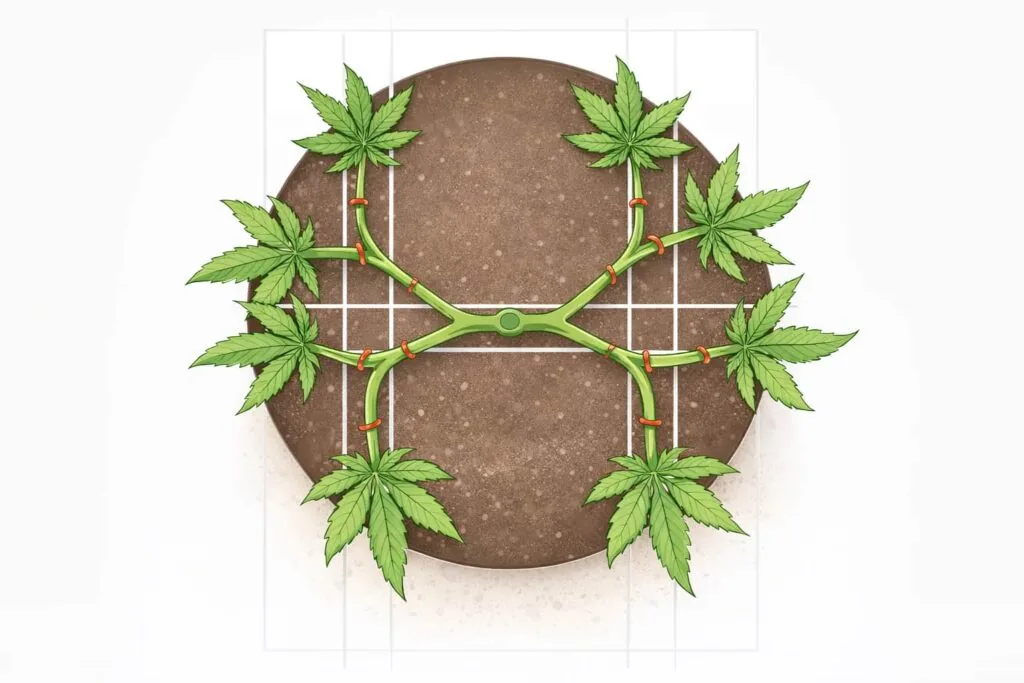
Mainlining cannabis is a high-control plant training technique that combines topping, node removal, and symmetrical growth shaping to create a plant with evenly sized main colas.
The goal of mainlining is not bigger plants.
The goal is to balance energy distribution.
By forcing the plant into a symmetrical structure early, each main cola receives similar light, nutrients, and hormonal signals.
How Mainlining Cannabis Works
Mainlining works by manipulating two key plant processes:
- Apical dominance
- Hormonal balance between nodes
When the main stem is topped and side growth is removed strategically, the plant is forced to redistribute growth hormones evenly across selected branches.
This creates:
- Uniform cola size
- Even canopy height
- Predictable structure
Mainlining is more invasive than low stress training and requires longer recovery time.
LST vs Mainlining : Key Differences
Mainlining and LST are often confused, but they serve different purposes.
| Technique | Stress Level | Control | Recovery Time |
|---|---|---|---|
| LST | Low | Moderate | Short |
| Mainlining | High | Very High | Long |
| Topping Only | Medium | Low | Moderate |
LST reshapes growth gradually.
Mainlining reshapes growth aggressively and early.
If you are new to training, mastering basic cannabis plant training before attempting mainlining is strongly recommended.
What Science Says About Mainlining Cannabis
Plant science gives us a clear framework for understanding why mainlining works.
Apical Dominance And Hormone Redistribution
Cannabis, like many plants, prioritizes growth at the top of the plant through apical dominance.
When the main stem is removed:
- Auxin distribution changes
- Lateral branches receive stronger growth signals
- Growth becomes more evenly distributed
This mechanism is well documented in plant physiology and applies to cannabis training techniques.
💡 Source: Apical dominance and plant hormone regulation
Stress And Recovery Are The Tradeoff
Mainlining introduces deliberate stress.
Each topping and node removal:
- Temporarily slows growth
- Forces recovery and rerouting of energy
- Requires healthy roots and stable conditions
Plants that are already stressed by environment, nutrition, or genetics respond poorly to mainlining.
When Mainlining Cannabis Makes Sense
Mainlining can be useful in specific situations.
Works Best If:
- You grow indoors with height limits
- You want uniform colas for even lighting
- You have long vegetative time available
- Plants are healthy and vigorous
Usually A Bad Idea If:
- You want fast harvests
- You grow autoflowers
- Plants are already stressed
- You are running short veg cycles
Mainlining prioritizes structure over speed.
Autoflowers And Mainlining
Mainlining is not recommended for autoflowering cannabis.
Autoflowers have limited vegetative time and do not recover well from high-stress techniques.
For autos, techniques like LST tie-down methods are far more effective and forgiving.
Common Mistakes When Mainlining Cannabis
| Mistake | Why It Causes Problems |
|---|---|
| Mainlining weak plants | Recovery is poor |
| Cutting too early | Stalls development |
| Rushing multiple toppings | Compounds stress |
| Ignoring recovery time | Reduces yield |
| Using mainlining on autos | Plants do not rebound |
Practical Decision Guide: Should You Mainline?
| Your Goal | Mainlining? |
|---|---|
| Maximum uniformity | Yes |
| Fast turnaround | No |
| Small grow tent | Yes |
| Beginner grow | No |
| Autoflower grow | No |
How To Mainline Cannabis Step-By-Step
Mainlining cannabis involves creating a central manifold (a hub) that distributes energy evenly to multiple main branches. The goal is a symmetrical plant structure where each cola has equal access to nutrients and light, resulting in uniform growth and predictable yields.
This method works best early in the vegetative stage, once the plant is strong, healthy, and producing steady new growth. If you are still new to pruning or training, it can help to first review the basics in our cannabis plant training guide.
Step 1: Wait Until The Plant Has 5–8 Nodes
Begin mainlining only when the plant has developed at least 5 to 8 nodes and shows vigorous, healthy growth.
At this point the main stem is thick enough to recover from topping without major stress.
Avoid mainlining weak, slow, or nutrient-stressed plants.
Step 2: Create The Manifold
Top the plant above the third node (counting from the base).
Then remove all lower growth below this point, including shoots and large fan leaves. You should now have a clean stem leading to two symmetrical branches at the third node.
This “Y-shape” is the foundation of the mainline. It resets apical dominance and equalizes growth energy between both sides of the plant.
Step 3: Train The Two Main Branches
Gently guide the two branches outward so they grow horizontally.
Use soft plant ties rather than rigid wire. The goal is to spread the branches without crushing or cutting the stems.
This step improves light exposure and prepares the plant for uniform branching.
Step 4: Let New Growth Develop, Then Top Again
Once each of the two main branches has grown several nodes, top each branch again so that you now have four main branches.
If you want eight main colas, repeat this process once more — but only after full recovery.
More colas always require more vegetative time.
Step 5: Maintain A Flat, Even Canopy
Continue shaping the branches so that each main cola sits at the same height.
If one grows ahead, lower it gently.
If one lags, let it rise slightly.
The goal is balance rather than force.
Step 6: Switch To Flower Only After Full Recovery
Wait until the plant shows:
- normal, healthy growth
- upright leaves
- even branch thickness
- no drooping or stress
Then transition to flowering.
Mainlining works best when the plant enters bloom strong, calm, and fully recovered.
Mainlining Timeline (Realistic Expectation)
| Stage | Timeframe |
|---|---|
| Establish plant | 2–3 weeks |
| First topping + recovery | 5–10 days |
| Second topping + shaping | 7–14 days |
| Final recovery | 7–10 days |
💡 Usually adds 2–3 weeks to veg.
Safety & Plant Health Notes
- Avoid mainlining unhealthy plants
- Avoid mainlining autoflowers
- Avoid stacking multiple stressors at once
- Keep environment stable throughout
Mainlining rewards calm consistency, not aggression.
Final Thoughts On Mainlining Cannabis
Mainlining cannabis is a precision technique, not a requirement.
It trades time and recovery for structure and uniformity.
Used correctly, it creates clean canopies and predictable results.
Used unnecessarily, it slows growth without real benefit.
If you want to explore advanced training techniques, start with healthy, resilient genetics that recover well from stress. Choosing stable High THC Seeds makes techniques like mainlining far more forgiving and effective.
Mainlining does not create better plants.
It reveals how good your fundamentals really are.
Final Thoughts On Mainlining Cannabis
Mainlining cannabis is a precision technique, not a requirement.
It trades time and recovery for structure and uniformity.
Used correctly, it creates clean canopies and predictable results.
Used unnecessarily, it slows growth without real benefit.
If you want to try mainlining, it helps to choose genetics that:
- grow vigorously in veg
- respond well to topping
- build strong central colas
- recover quickly after stress
Good examples include hybrid and indica-leaning seeds such as:
These strains typically produce sturdy branching, structured growth, and consistent cola development, which makes the mainlining process smoother and more predictable.
Mainlining does not create quality on its own.
It reveals how strong your genetics and fundamentals really are.
FAQ: Mainlining Cannabis
Does mainlining increase yield?
Not always. It improves uniformity more than total yield.
Is mainlining better than LST?
No. It is more controlled but also more stressful.
How many main colas should you create?
Most growers use 4, 8, or 16, depending on space and veg time.
Can mainlining fix poor genetics?
No. Genetics determine potential. Training only shapes growth.