

| Growth Stage | VPD Target (kPa) | Temperature (°F) | Humidity (%) | What Happens Here |
| Seedling / Clone | 0.4 – 0.8 | 70 – 77 | 70 – 80 | Root establishment, minimal transpiration stress |
| Early Veg | 0.8 – 1.0 | 75 – 80 | 60 – 70 | Rapid leaf development, building structure |
| Late Veg | 1.0 – 1.2 | 78 – 82 | 55 – 65 | Aggressive growth, heavy nutrient uptake |
| Early Flower | 1.0 – 1.4 | 76 – 80 | 50 – 60 | Stretch phase, flower site formation |
| Mid Flower | 1.2 – 1.5 | 75 – 80 | 45 – 55 | Bud development, peak nutrient demand |
| Late Flower | 1.4 – 1.6 | 70 – 76 | 40 – 50 | Ripening, mold prevention, terpene preservation |
Vapor Pressure Deficit (VPD) is the single most important environmental metric in your grow room that most growers completely ignore. It measures the difference between how much moisture the air currently holds and the maximum amount it could hold at the current temperature. In simple terms, VPD tells you how hard the air is “pulling” moisture out of your plants.
Here is why this matters more than temperature or humidity alone: the same 60% relative humidity produces a VPD of 1.17 kPa at 75°F, but a VPD of 1.59 kPa at 85°F. That is a 36% difference in the drying force acting on your plants, even though your humidity reading has not changed at all. This is exactly why growers who only monitor temperature and humidity still encounter unexplained deficiencies, wilting, and mold.
When VPD is dialed in correctly, your plants open their stomata fully, allowing maximum CO2 absorption, optimal transpiration rates, and efficient nutrient transport from roots to canopy. When VPD is wrong, your plants either suffocate (too low) or dehydrate (too high), and the symptoms often mimic nutrient deficiencies that send growers chasing the wrong problem.
You do not need to memorize the math. But understanding what is happening helps you make better decisions when something goes wrong.
VPD = SVP × (1 – RH / 100)
Where SVP (Saturation Vapor Pressure) is the maximum moisture the air can hold at your current temperature, and RH is your relative humidity percentage. The result is measured in kilopascals (kPa).
There is one critical nuance that separates good growers from great ones: Leaf VPD is not the same as Air VPD. Your plant leaves are typically 2 to 5°F cooler than the surrounding air because of transpiration cooling. This means the plant experiences a slightly different VPD than what your thermometer and hygrometer suggest. Under LED lighting, the leaf temperature offset is smaller (1 to 3°F) because LEDs emit less radiant heat than HPS bulbs. Under HPS, leaves can be 4 to 6°F cooler due to the higher infrared radiation causing more transpiration.
For practical purposes, if you are growing under LEDs, subtract 2°F from your air temperature when reading the VPD chart. Under HPS, subtract 4°F.
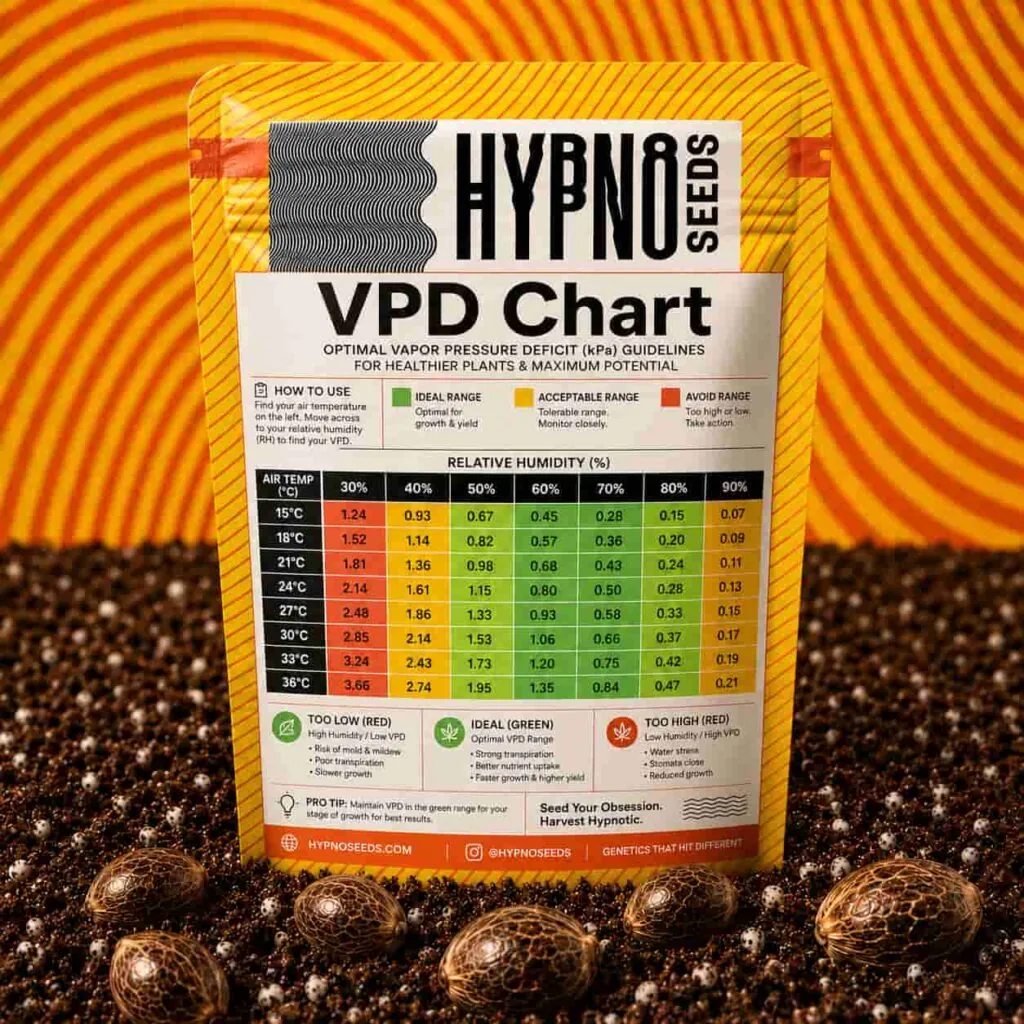
This chart shows VPD values in kPa for every practical combination of temperature and relative humidity. Find your temperature along the top, slide down to your humidity row, and read the number. Then compare it to the stage targets in the TL;DR table above.
| RH (%) | 65°F | 68°F | 70°F | 73°F | 75°F | 78°F | 80°F | 82°F | 85°F | 88°F |
| 40% | 1.26 | 1.37 | 1.49 | 1.62 | 1.75 | 1.90 | 2.05 | 2.21 | 2.39 | 2.58 |
| 45% | 1.15 | 1.25 | 1.36 | 1.48 | 1.60 | 1.74 | 1.88 | 2.02 | 2.19 | 2.36 |
| 50% | 1.05 | 1.14 | 1.24 | 1.35 | 1.46 | 1.58 | 1.71 | 1.84 | 1.99 | 2.15 |
| 55% | 0.94 | 1.03 | 1.12 | 1.21 | 1.31 | 1.43 | 1.54 | 1.66 | 1.79 | 1.94 |
| 60% | 0.84 | 0.91 | 0.99 | 1.08 | 1.17 | 1.27 | 1.37 | 1.47 | 1.59 | 1.72 |
| 65% | 0.73 | 0.80 | 0.87 | 0.94 | 1.02 | 1.11 | 1.20 | 1.29 | 1.39 | 1.51 |
| 70% | 0.63 | 0.68 | 0.74 | 0.81 | 0.87 | 0.95 | 1.03 | 1.10 | 1.19 | 1.29 |
| 75% | 0.52 | 0.57 | 0.62 | 0.67 | 0.73 | 0.79 | 0.86 | 0.92 | 0.99 | 1.08 |
| 80% | 0.42 | 0.46 | 0.50 | 0.54 | 0.58 | 0.63 | 0.68 | 0.74 | 0.80 | 0.86 |
| 85% | 0.31 | 0.34 | 0.37 | 0.40 | 0.44 | 0.47 | 0.51 | 0.55 | 0.60 | 0.65 |
| 90% | 0.21 | 0.23 | 0.25 | 0.27 | 0.29 | 0.32 | 0.34 | 0.37 | 0.40 | 0.43 |
Color guide: Values between 0.4–0.8 = seedling zone. Values between 0.8–1.2 = veg zone, values between 1.0–1.5 = flower zone. Values above 1.6 = stress zone.
One of the biggest gaps in existing VPD guides is that they give you broad ranges (“0.8–1.2 for veg”) without telling you how to transition between stages. Here is a week-by-week roadmap that shows you exactly when and how to shift your VPD targets.
| Week | Stage | VPD Target (kPa) | Temp (°F) | RH (%) | Notes |
| 1 | Seedling | 0.4 – 0.6 | 72 – 76 | 75 – 80 | Dome on, minimal airflow |
| 2 | Seedling | 0.6 – 0.8 | 74 – 78 | 70 – 75 | Remove dome, introduce gentle airflow |
| 3 | Early Veg | 0.8 – 1.0 | 76 – 80 | 60 – 70 | First topping, roots established |
| 4 | Mid Veg | 0.9 – 1.1 | 78 – 82 | 55 – 65 | Training begins, nutrient uptake increases |
| 5 | Late Veg | 1.0 – 1.2 | 78 – 82 | 55 – 60 | Final week before flip |
| 6 | Transition (Flower Wk 1) | 1.0 – 1.2 | 76 – 80 | 55 – 60 | Stretch begins, maintain veg VPD |
| 7 | Early Flower (Wk 2) | 1.0 – 1.3 | 76 – 80 | 50 – 55 | Begin gradual humidity reduction |
| 8 | Mid Flower (Wk 3) | 1.2 – 1.4 | 75 – 80 | 48 – 55 | Buds forming, increase VPD slightly |
| 9 | Mid Flower (Wk 4) | 1.2 – 1.5 | 75 – 80 | 45 – 52 | Peak feeding, peak transpiration |
| 10 | Late Flower (Wk 5) | 1.3 – 1.5 | 72 – 78 | 42 – 50 | Buds fattening, mold prevention |
| 11 | Ripening (Wk 6-7) | 1.4 – 1.6 | 70 – 76 | 40 – 48 | Trichome maturation, begin flush |
| 12 | Final Flush (Wk 7-8) | 1.4 – 1.6 | 68 – 74 | 38 – 45 | Maximum mold protection, harvest prep |
The key principle is gradual escalation. You never want to jump from 0.8 kPa to 1.5 kPa overnight. The plant needs time to adjust its transpiration rate. Aim for no more than 0.2 kPa increase per week.
Understanding the five mechanisms that VPD controls will help you diagnose problems faster than any deficiency chart ever could.
1. Stomata Opening. As VPD increases, the stomata (tiny pores on the underside of leaves) begin to close. This is a survival mechanism. The plant senses that the air is pulling too much moisture, so it restricts the openings to prevent dehydration. The problem is that closed stomata also means no CO2 absorption, which directly halts photosynthesis.
2. Transpiration Rate. As VPD increases, the “pull” on the plant’s internal moisture intensifies. Even with partially closed stomata, the plant loses water faster. This creates a suction effect that pulls water and dissolved nutrients up from the roots through the xylem. In moderation, this is beneficial. In excess, it causes nutrient burn and dehydration.
3. CO2 Uptake. Because CO2 enters through the stomata, anything that closes them reduces carbon fixation. This is why high VPD environments often produce slower growth even when nutrients and light are perfect. The plant simply cannot absorb enough CO2 to fuel photosynthesis at full capacity.
4. Nutrient Transport. The transpiration stream is the primary mechanism for moving calcium, magnesium, and other immobile nutrients from roots to leaves. When VPD is too low and transpiration slows, calcium cannot reach the newest growth. This produces symptoms that look exactly like calcium deficiency but cannot be fixed by adding more calcium to the reservoir.
5. Plant Stress Response. When VPD exceeds the plant’s comfort zone, it triggers stress hormones (abscisic acid) that redirect energy from growth and flower production toward survival. The plant essentially enters “emergency mode,” prioritizing water conservation over biomass production.
This is a critical distinction that almost no VPD guide addresses, yet it affects every indoor grower.
| Factor | LED Grow Lights | HPS Grow Lights |
| Radiant Heat on Canopy | Low (minimal infrared) | High (significant infrared) |
| Leaf Temperature Offset | 1 – 3°F below air temp | 3 – 6°F below air temp |
| Practical Impact | Leaf VPD is closer to Air VPD | Leaf VPD is significantly lower than Air VPD |
| Adjustment Needed | Subtract 2°F from air temp when reading chart | Subtract 4-5°F from air temp when reading chart |
| Common Mistake | Running humidity too low (thinking VPD is lower than it is) | Running humidity too high (overcompensating for heat) |
If you recently switched from HPS to LED and noticed your plants seem to be transpiring less, growing slower, or showing calcium deficiency symptoms, this is likely the reason. Under LEDs, the leaves are warmer relative to the air (smaller offset), which means the actual Leaf VPD is higher than you think. You may need to raise your humidity by 5 to 10% compared to what worked under HPS.
This is the section that no other VPD guide provides. Instead of guessing whether your problem is nutrient-related or environmental, use this table to match your symptoms to the likely VPD issue and its fix.
| Symptom | Likely VPD Issue | What Is Happening | Fix |
| Calcium deficiency on new growth (curled tips, brown spots) | VPD too low (below 0.6 kPa) | Transpiration too slow to transport calcium upward | Raise VPD by lowering humidity or raising temp |
| Nutrient burn on leaf tips despite normal EC | VPD too high (above 1.6 kPa) | Excessive transpiration pulling too many salts into leaves | Lower VPD by raising humidity or lowering temp |
| Wilting even though medium is moist | VPD too high (above 1.8 kPa) | Plant losing water faster than roots can absorb | Immediately raise humidity and lower light intensity |
| Powdery mildew or mold on leaves | VPD too low (below 0.4 kPa) | Moisture condensing on leaf surfaces | Raise VPD, increase airflow, defoliate dense areas |
| Slow growth despite good nutrients and light | VPD too high (stomata closed) | CO2 uptake restricted, photosynthesis limited | Lower VPD to 0.8-1.2 range to open stomata |
| Stretchy, soft stems in veg | VPD too low (below 0.6 kPa) | Minimal transpiration = weak cell wall development | Raise VPD gradually to 0.8-1.0 range |
| Leaf edges curling upward (taco-ing) | VPD too high + heat stress | Leaves curling to reduce surface area exposed to dry air | Lower temp, raise humidity, increase distance to lights |
| Excessive water consumption (drinking pot dry daily) | VPD too high (above 1.5 in veg) | Transpiration rate exceeding normal demand | Lower VPD or increase pot size |
If you are supplementing CO2 in your grow room (running 1,000 to 1,500 ppm), your VPD targets change. CO2 supplementation allows the plant to tolerate higher VPD levels without closing its stomata, because the increased CO2 concentration compensates for the reduced stomata opening.
| CO2 Level | VPD Adjustment | Reasoning |
| Ambient (~400 ppm) | Use standard targets above | Normal stomata behavior |
| 800 – 1,000 ppm | Add 0.1 – 0.2 kPa to targets | Stomata can stay open at slightly higher VPD |
| 1,200 – 1,500 ppm | Add 0.2 – 0.4 kPa to targets | High CO2 concentration forces absorption even with smaller stomata openings |
This means that in a CO2-enriched flower room running 1,200 ppm, your optimal VPD during mid-flower might be 1.4 to 1.8 kPa rather than the standard 1.2 to 1.5 kPa. The higher VPD drives more aggressive transpiration and nutrient uptake, while the elevated CO2 ensures photosynthesis continues at full speed despite partially restricted stomata.
When your lights turn off, the temperature in your grow room drops. If humidity stays the same, VPD drops significantly. This is when mold, powdery mildew, and bud rot strike. Most growers focus exclusively on daytime VPD and completely ignore what happens during the dark period.
During lights-off, aim to keep VPD above 0.8 kPa at minimum. If your nighttime temperature drops more than 10°F below your daytime temperature, you will almost certainly need a dehumidifier running during the dark period to prevent condensation on your flowers.
The ideal lights-off temperature drop is 5 to 8°F. Anything more than 10°F creates a dangerous dew point situation where moisture literally condenses on your buds. This is the number one cause of bud rot in late flower, and it is entirely preventable with proper nighttime VPD management.
Not all cannabis strains respond to VPD the same way. This is something that no other guide discusses, but it makes a significant difference in practice.
Heavy feeders (like Peach Crescendo, OG Kush, Gorilla Glue): These aggressive strains with high metabolic rates can tolerate and even benefit from slightly higher VPD (add 0.1 to 0.2 kPa to standard targets). The increased transpiration drives more nutrient uptake, which these hungry plants need to reach their full potential.
Light feeders (like Blueberry Cupcake, Northern Lights, most autoflowers): These more sensitive strains prefer the lower end of each VPD range. Pushing VPD too high on a light feeder will cause nutrient burn before it causes any growth benefit. Stay conservative.
Sativa-dominant strains (like Haze varieties, Durban Poison): These strains evolved in equatorial climates with high humidity. They tend to prefer slightly lower VPD throughout their lifecycle (subtract 0.1 to 0.2 kPa from standard targets). Their larger, thinner leaves transpire faster naturally.
Indica-dominant strains (like LA Confidential, GDP, Afghan): These strains evolved in arid, mountainous regions. They tolerate higher VPD well and often produce denser flowers when pushed toward the upper end of the recommended range.
1. Measuring at the wrong height. Your hygrometer must be at canopy level. Floor-level readings are always more humid, and ceiling readings are always drier. A sensor placed at the wrong height can give you readings that are off by 10% or more.
2. Changing temperature AND humidity at the same time. When your VPD is off, adjust only one variable. If you change both simultaneously, you cannot determine which adjustment worked, and you risk overshooting in the opposite direction.
3. Ignoring the lights-off period. As discussed above, nighttime VPD management is just as important as daytime. A dehumidifier on a timer is not optional in late flower.
4. Using air temperature instead of leaf temperature. If you are serious about VPD, invest in a $15 infrared thermometer and measure your actual leaf surface temperature. The 2 to 5°F difference between air and leaf temperature changes your VPD reading significantly.
5. Treating VPD as a single number rather than a range. Your VPD will fluctuate throughout the day as temperatures rise and fall. The goal is to stay within the target band, not to hit one exact number. A swing of 0.1 to 0.2 kPa throughout the day is completely normal and healthy.
6. Not accounting for plant density. A canopy full of large, transpiring plants will naturally raise the humidity in your grow space. As your plants grow larger through veg, you may need to increase your dehumidification capacity to maintain the same VPD.
| Equipment | Purpose | Budget Option | Pro Option |
| Thermometer/Hygrometer | Measure temp and RH at canopy | Govee WiFi sensor ($25) | Pulse Pro with logging ($200) |
| Infrared Thermometer | Measure leaf surface temperature | Any IR gun ($15-30) | Apogee SI-131 ($150) |
| Humidifier | Raise humidity when VPD is too high | Ultrasonic cool mist ($40) | Commercial humidifier ($200+) |
| Dehumidifier | Lower humidity when VPD is too low | Small portable unit ($60) | Quest 105/155 ($500-800) |
| Oscillating Fans | Eliminate microclimates in canopy | Clip-on fans ($20 each) | AC Infinity oscillating ($80) |
| Exhaust Fan + Controller | Manage air exchange and temp | AC Infinity T4 ($100) | AC Infinity T6 with controller ($180) |
The minimum investment for proper VPD management is approximately $60 to $80: a decent thermometer/hygrometer combo, an IR thermometer, and a humidifier or dehumidifier depending on your climate.
VPD is not complicated once you understand the core principle: it measures how hard the air is pulling moisture from your plants. Too much pull and they dehydrate. Too little and they suffocate. The sweet spot changes as your plants grow, and the key to mastering it is gradual adjustment and consistent monitoring.
The growers who dial in their VPD consistently report 15 to 25% yield increases compared to those who only monitor temperature and humidity separately. It is the single highest-impact environmental optimization you can make without spending money on new lights or nutrients.
Start with the chart and the week-by-week targets in this guide. Invest in a decent sensor and an IR thermometer. Adjust one variable at a time. And remember: if your plants are showing deficiency symptoms that do not respond to nutrient changes, the answer is almost always in the environment.
Looking for strain-specific VPD recommendations? Check out our grow guides for Peach Crescendo, Blueberry Cupcake, and LA Confidential, where we include tailored VPD and feeding schedules for each cultivar.


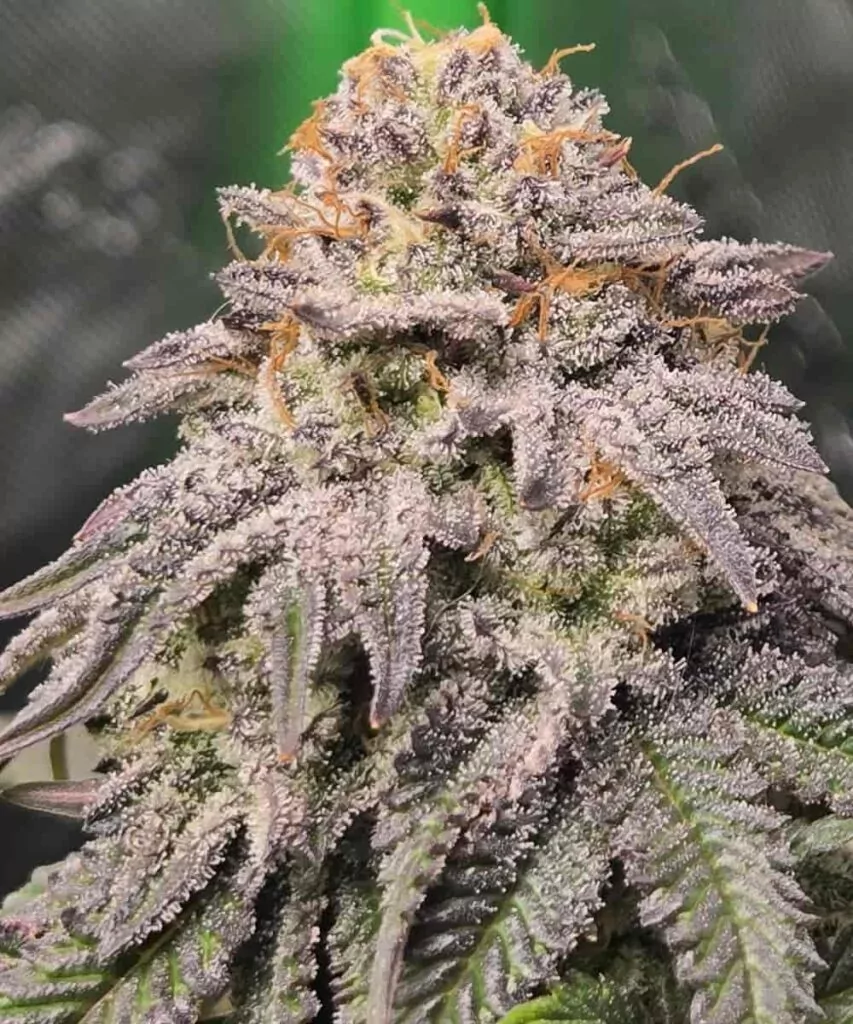


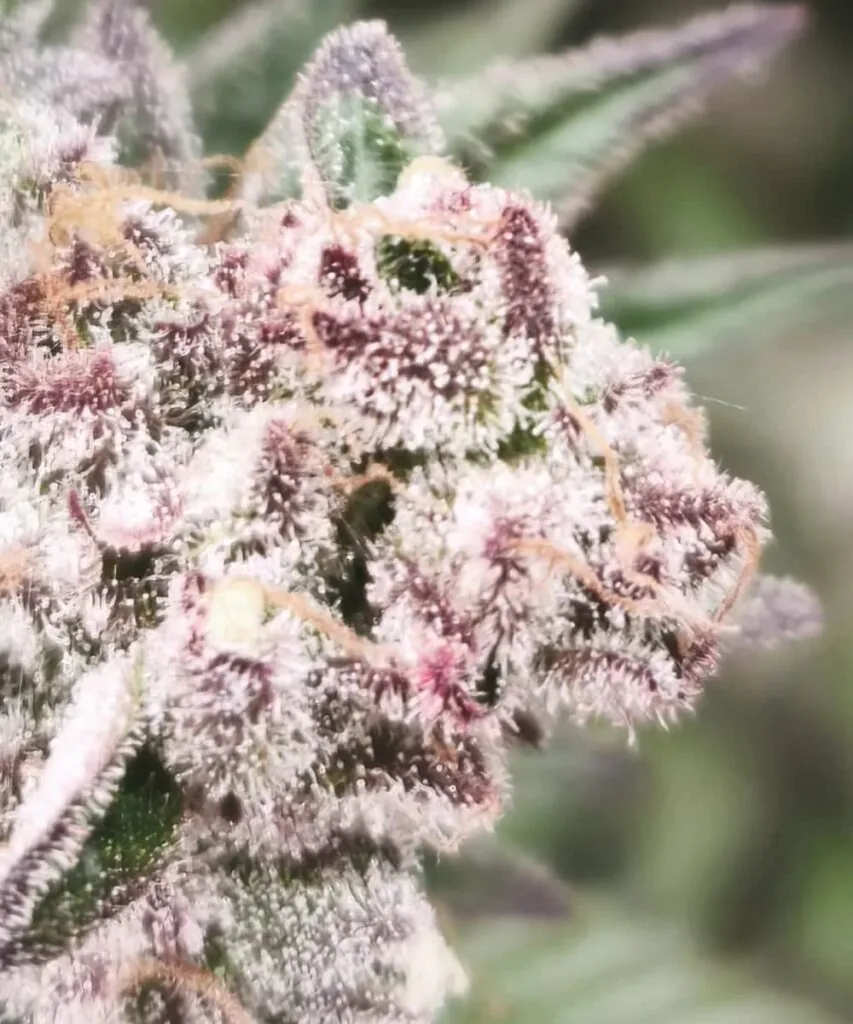
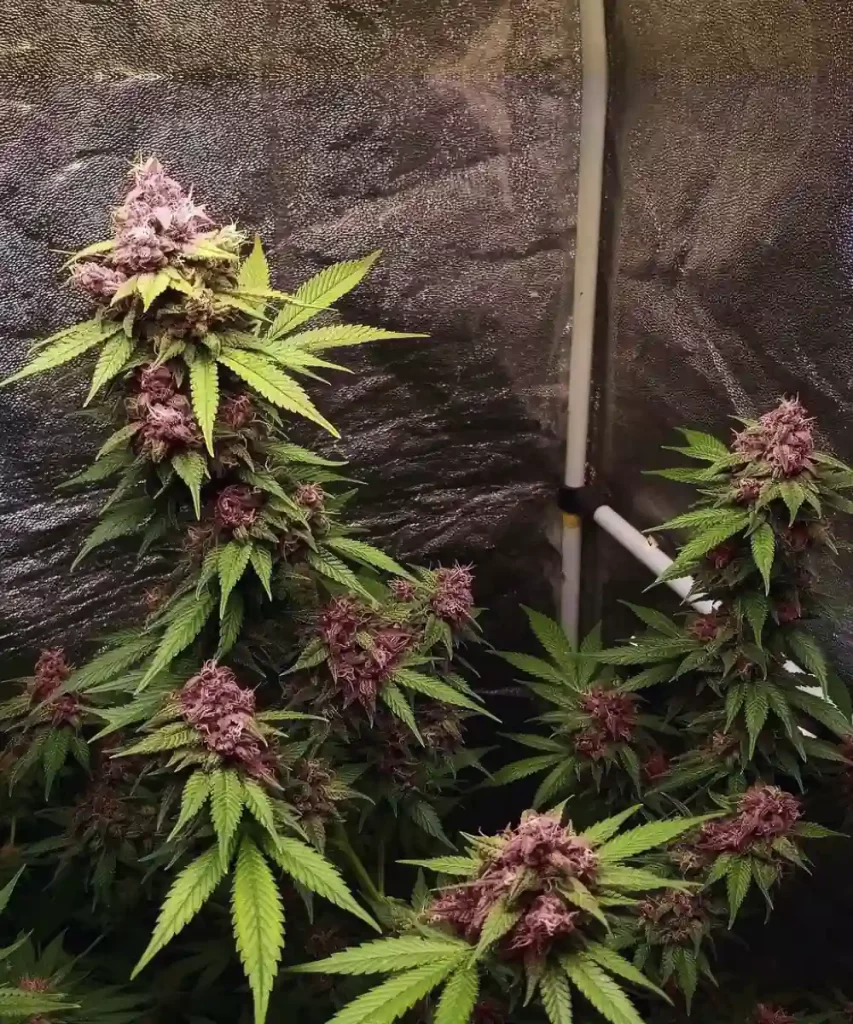
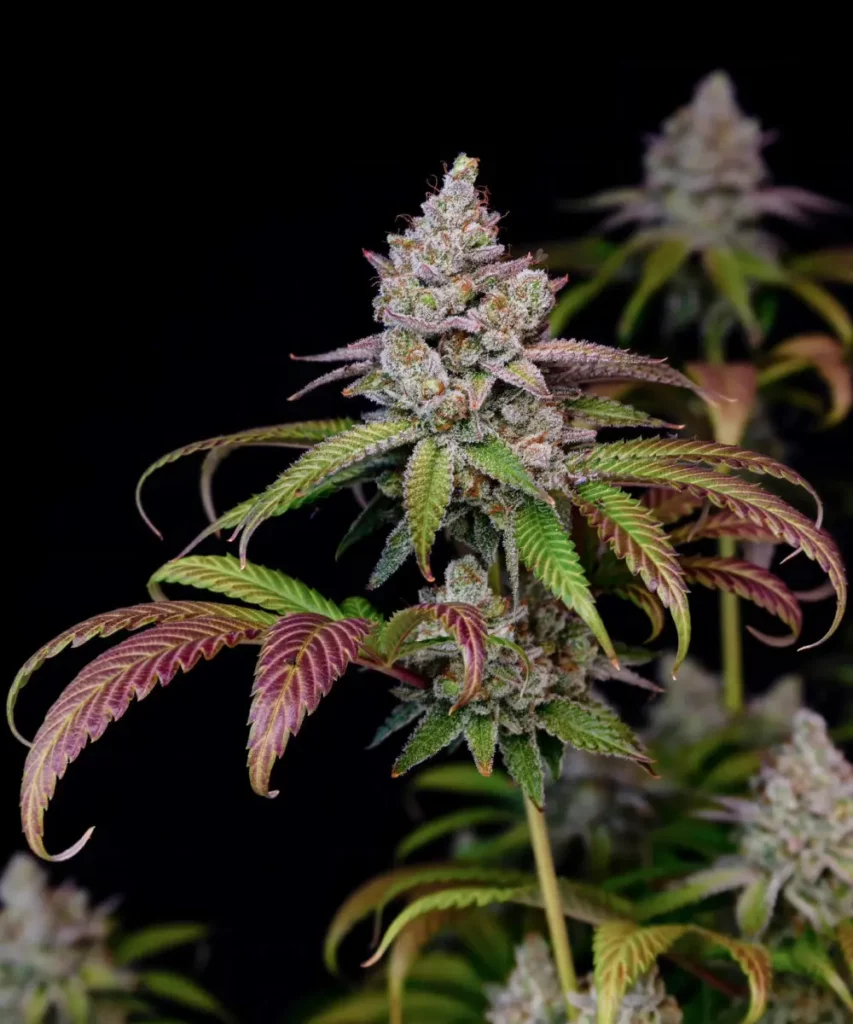
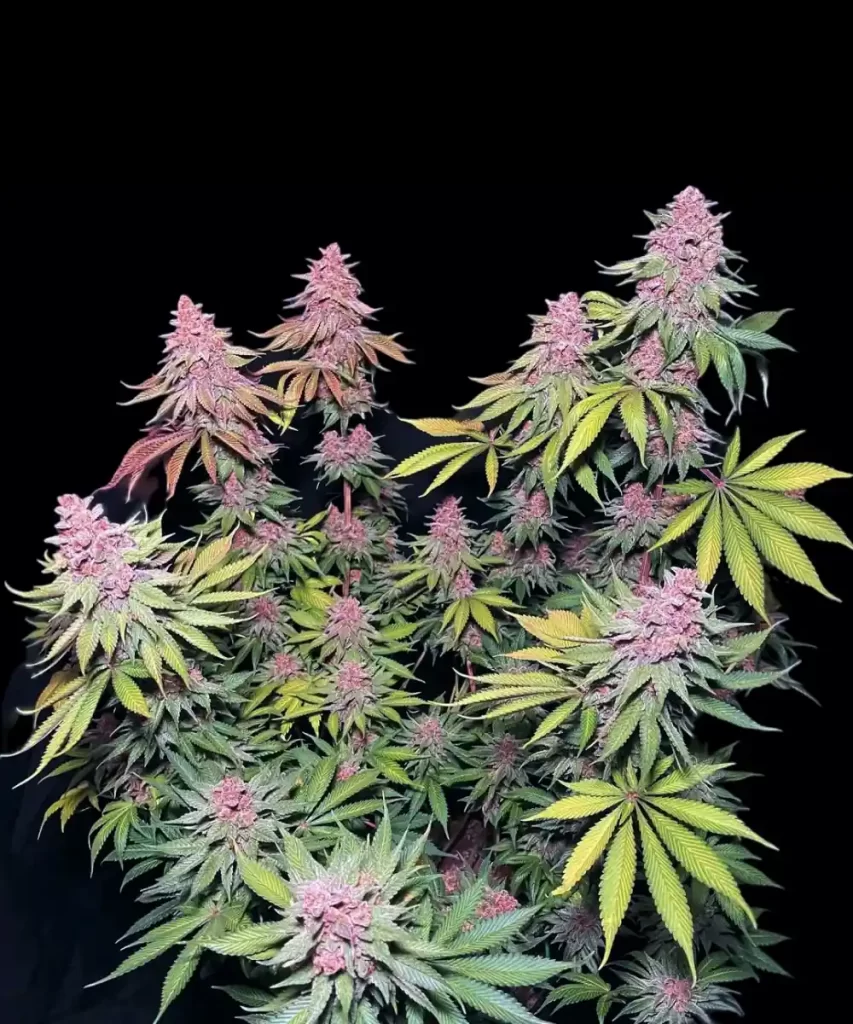

I planted 10 Super Boof seeds, and all germinated without a hitch. The plants grew strong and healthy, producing dense, frosty buds with a sweet, earthy aroma. The high is uplifting yet relaxing—a perfect balance. Impressive yield too, even with minimal effort

I’ve been growing weed for 30+ years, and to be honest, it’s quite difficult to surprise me. After a few decades of facing different strains, changing growing conditions, and solving whatever problem you could possibly think of, by then, I believe I’ve seen it all in cannabis growing.
Gary Payton defied every single one of my expectations.
The plant thrived, growing to an impressive 6 feet in what seemed like a blink of an eye. It quickly filled out with buds and displayed better smell each day, showing solid proof of superior genetics. The buds were tight, aromatic, and a source of immense pride, surpassing the outcome of many of my previous endeavors.
Hypno Seeds with their Gary Payton strain has won my complete admiration and loyalty. Outstanding genetics in this plant have truly turned what I always thought of to be an experiment with negligible expectations into one of the most satisfying grows of my long career.
Looking forward, my excitement for the next growing season is unparalleled. I can’t wait to see how much I can take these strains, especially with the attention that Gary Payton really does deserve right from the start.

TRUE MAGIC! This strain really stands out. I am trying Hypno Seeds for the first time and I surely made the right choice. I will be ordering more RS11 seeds just to keep this beauty in my garden for the upcoming season. Growing in Virginia and it’s only shown perfection by now.

Starting my latest grow, I decided to try out some Blackberry Kush from Hypno… I planted her on a whim alongside my other favorites. Hypno Seeds said it had to be a powerful plant with rich, fruity scents… Seeing is believing. She developed purplish hues and dense resin coated buds and quickly took center stage in my garden and produced much more than expected. The buds are tightly packed, literally bursting with the heady aroma. The yield? Very impressive for her conditions…
Germinated three seeds using the paper towel method with100% success rate within 48 hours. Planted in 5 gallon pots with living soil under a 315W CMH light. Plants remained compact (3.5 ft) with thick lateral branching, showing high resistance to humidity and minor nutrient fluctuations. Yield per plant: 5.8 oz of extremely dense, trichome-heavy buds. Smell profile during flower: sharp pine, pepper, and a hint of citrus. Harvested at week 9, after trichomes showed 30% amber for peak sedative effects. Smoke report: Potent. Deep relaxation without full sedation. Ideal for stress relief.


