
Controlling Temperature in a Grow Room: How to Keep Cannabis Healthy and Stress Free
Controlling temperature is one of the most important parts […]


 0
0
Humidity in cannabis growing refers to relative humidity (RH) — the percentage of moisture in the air compared to the maximum the air can hold at a given temperature.
The best humidity for cannabis is not one single number.
It is a range that supports plant health while preventing mold.
Humidity affects:
Dialing this in is as important as feeding or lighting.
For background climate context, you can also review our guide to grow room temperature and humidity.
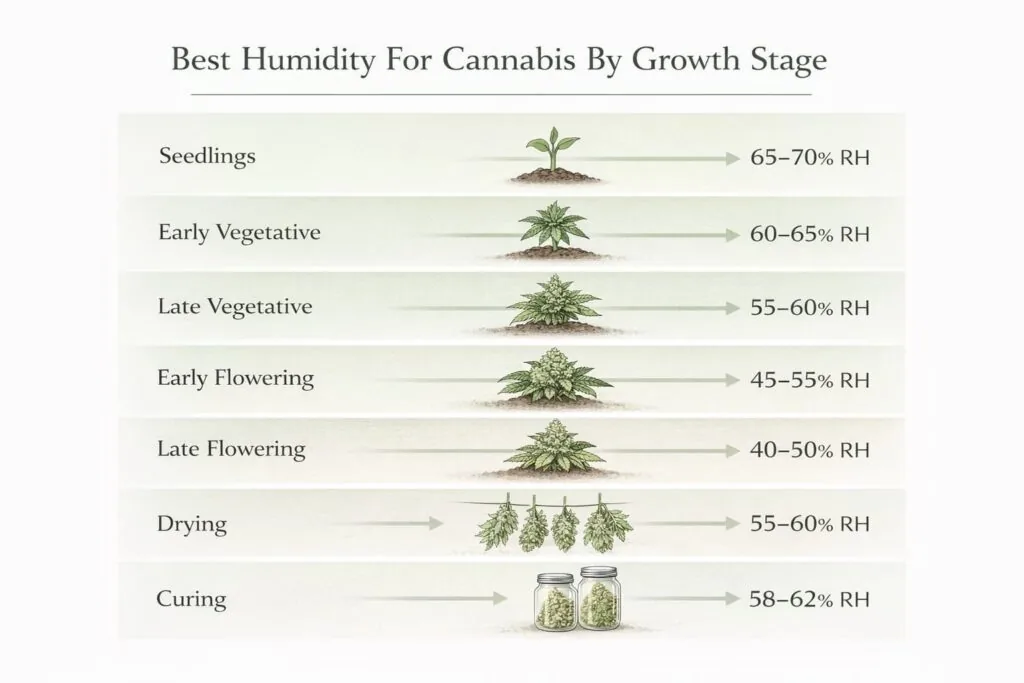
Cannabis needs more humidity early in life and less as it matures.
Here are safe target ranges:
| Stage | Best RH Range | Why It Works |
|---|---|---|
| Seedlings | 65–70% | Prevents drying and stress |
| Early Veg | 60–65% | Supports strong leafy growth |
| Late Veg | 55–60% | Balances growth and transpiration |
| Early Flower | 45–55% | Reduces mold risk |
| Late Flower | 40–50% | Protects terpenes and density |
| Drying | 55–60% | Prevents harsh, brittle flower |
| Curing | 58–62% | Stabilizes moisture evenly |
Drying and curing humidity control are covered in detail in our guides to curing cannabis and flushing cannabis in the post-harvest education cluster.
Humidity affects how quickly water evaporates through leaf pores (stomata). This process is called transpiration.
The balance shifts with age.
Seedlings need protection.
Flowering plants need airflow and dryness.
Seedlings have tiny roots and cannot drink water efficiently yet. Higher humidity prevents dehydration and curling.
Too little humidity here can cause:
Gentle, stable conditions matter more than perfect precision.
In veg, cannabis builds:
Moderately high humidity keeps stress low and growth steady — especially when plant training techniques like low stress training or topping are used.
Too much humidity in veg may slow transpiration.
Too little humidity may cause leaf stress.
Flowering increases the risk of:
Lower humidity:
This stage benefits greatly from good airflow and correct temperature control, which we cover more in the guide to controlling grow room temperature.
Drying and curing humidity determine smoothness and aroma far more than flushing.
Too dry and buds become brittle.
Too wet and mold risk rises.
For full context, see our guide on curing cannabis to understand why humidity stabilization improves smoke quality.
Plant physiology gives us a clear picture of why humidity matters.
When air is dry, water leaves the leaves faster.
When air is humid, transpiration slows.
This affects:
💡 Source: Plant transpiration and humidity physics
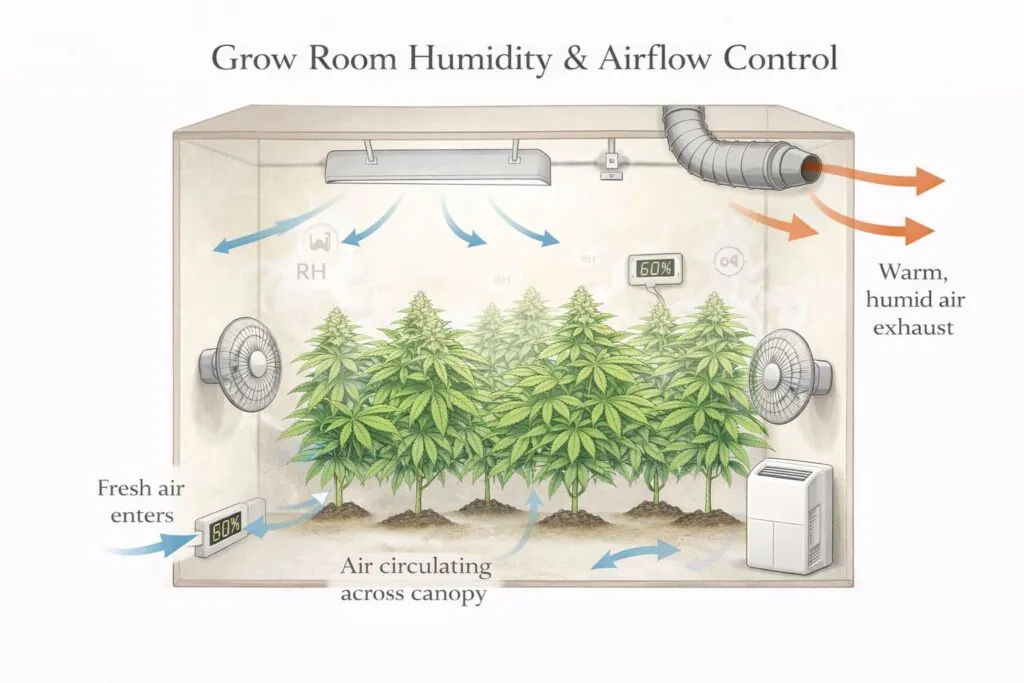
High humidity plus poor airflow creates ideal mold conditions inside dense cannabis flowers.
💡 Source: Botrytis (bud rot) infection conditions
Stable environments protect volatile terpene compounds.
💡 Source: Terpene volatility and environmental sensitivity
| Problem | Likely RH Issue | Fix |
|---|---|---|
| Crispy seedlings | Too dry | Increase RH |
| Drooping in veg | Too humid | Add airflow |
| Bud rot | High RH in flower | Lower RH + ventilation |
| Harsh smoke | Overly dry drying room | Raise RH slightly |
| Flat aroma | Extreme temp or RH swings | Stabilize environment |
Humidity swings are often worse than slightly imperfect averages.
Useful equipment includes:
Place hygrometers near plant canopy height for accuracy.
There is no single best humidity for cannabis.
There are best ranges, and they change through the life cycle.
If you keep humidity:
you’ll support plant health, aroma, potency, and smooth smoke.
Good humidity control works best when paired with healthy genetics that grow predictably and handle normal environmental changes calmly. Choosing strong THC seeds gives you plants that respond well to optimized humidity and produce consistent results across different environments.
Humidity control does not grow the plant for you.
It allows the plant to show its full potential.
Controlling temperature is one of the most important parts […]

Growing cannabis can be a tricky endeavor, but autoflowers […]

When it comes to growing weed successfully, choosing the best […]

If you want bigger yields, better terpenes, and smoother […]
Are you 21 or older?
You must verify that you are 21 years or older to enter this website. By proceeding, you are also agreeing to our terms and conditions, as well as consenting to the use of cookies on this site.